I Built the Practice Tool I Wish I'd Had as an Accounting Student. Here's a Full Walkthrough.
The founder walks through the full accounting cycle on iLove-Accounting — journal entries to cash flows, instant AI grading, Excel mode, and the Diamond credential.
Full disclosure, right up front: I built iLove-Accounting.com. What follows is not an independent review. It is the founder walking you through exactly what a student gets, so you can judge it with your own eyes.
Here is why I built it. I earned my Bachelor’s in Accounting at 53, after immigrating to the US at 47. I sat in front of blank journals, understood the lecture perfectly, and still did not know where to start. That feeling is the number one reason accounting students fall behind. Not intelligence. Not effort. Practice. You cannot master the accounting cycle by reading about it. You master it by doing it, again and again, until it becomes automatic, and most courses simply do not give you enough reps before the exam arrives.
That is the gap I set out to close. Here is how it works, step by step.
You Work the Entire Cycle Yourself
The platform is built around the full accounting cycle, broken into seven chapters. Each one is a step you actually perform, not a video you watch: journal entries, T-accounts, trial balance, income statement, statement of owner’s equity, balance sheet, and statement of cash flows.
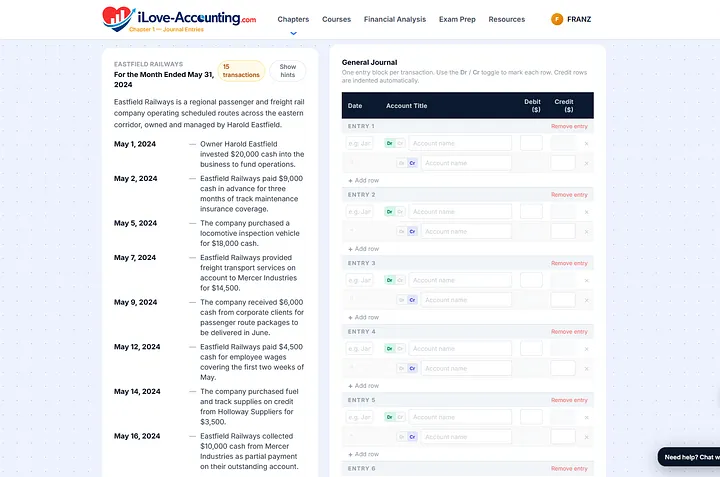
You start with a generated scenario and record the journal entries yourself.
See the Dr/Cr toggle on each entry line? You choose whether each account is debited or credited yourself. That small decision is the heart of double-entry bookkeeping, and making it yourself over and over is how it becomes second nature. You are not picking answers from a multiple choice list. You are doing the actual work an accountant does.
Every Step Is Checked Instantly, With Precise Feedback
This is the feature I cared about most. The moment you finish a step, the AI checks your work, and the feedback is specific. It does not just say wrong. It tells you exactly what is off, why, and how to fix it.
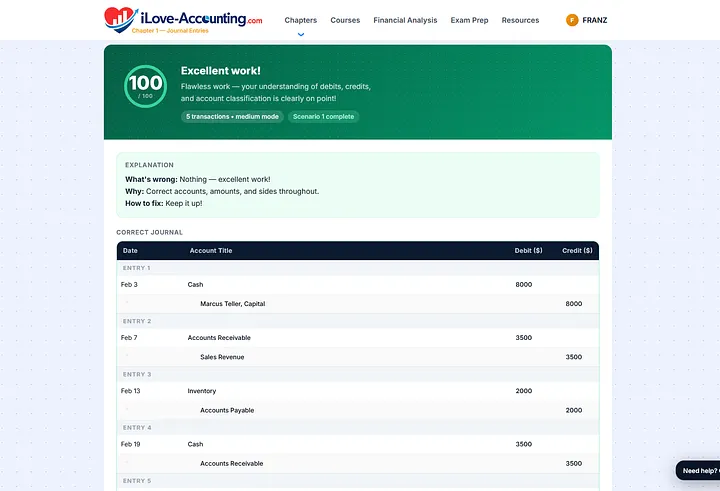
Normally, if you do a problem wrong, you find out days later when it comes back graded, by which point the mistake has hardened. Here you catch it the instant it happens, while the logic is still fresh, so you correct it instead of repeating it.
You Post the Ledgers and Prove the Balance
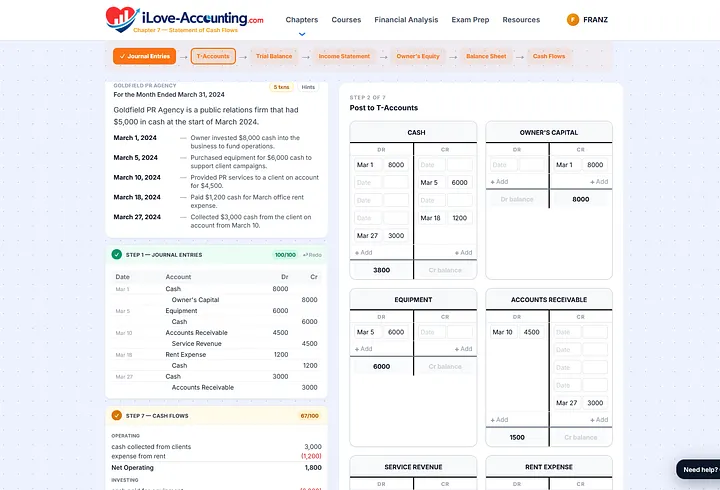
After the journal, you post to the T-accounts and watch each account’s balance take shape.
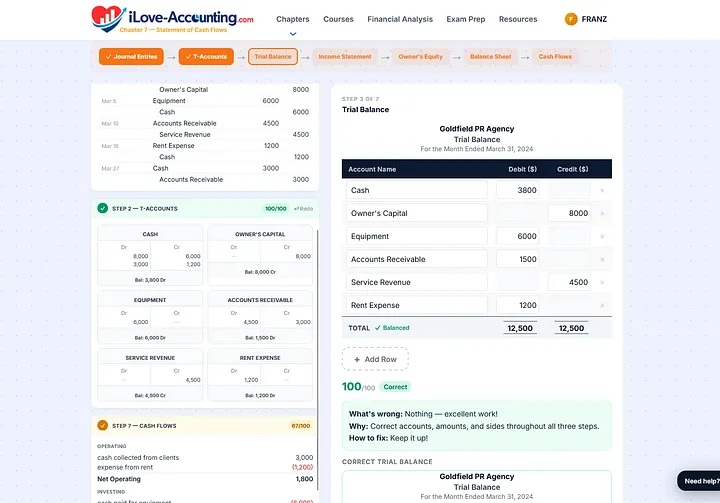
Then you bring every balance into the trial balance and prove that debits equal credits, the checkpoint that has to hold before any statement can be trusted.
You Build the Financial Statements From Scratch
Using the balances you just proved, you build each statement yourself.
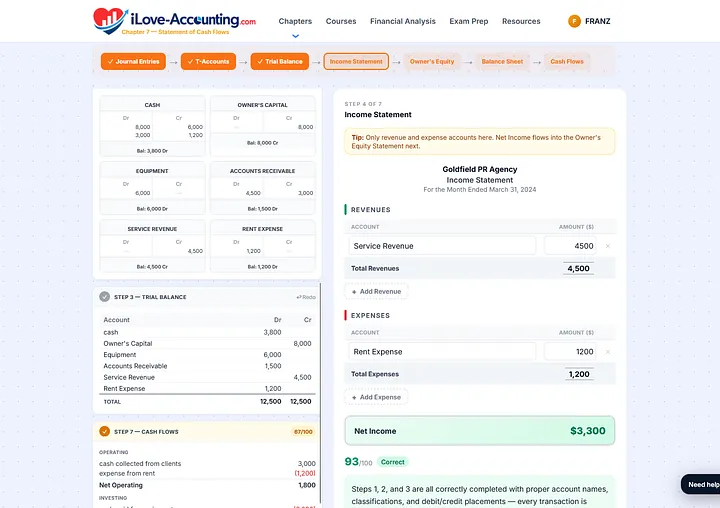
Working through the income statement, the statement of owner’s equity, the balance sheet, and the statement of cash flows in sequence is what finally makes the cycle click. You see, with your own hands, how net income flows into equity, how equity flows into the balance sheet, and how it all ties together. No textbook diagram teaches that the way doing it does.
It Gets Harder as You Get Better
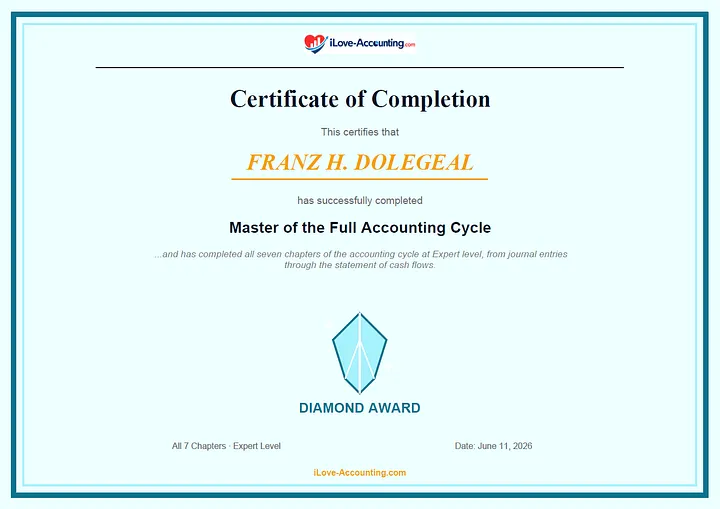
Every chapter ramps from easy to expert, so you are always practicing at the edge of your ability instead of coasting. And as you progress, you earn certificates, Bronze through Diamond. The Diamond is the top tier, awarded for mastering the entire cycle at the expert level, and it is recorded from your actual graded work, not self-reported.
There Is a Real Excel Mode Too
Alongside the guided web version, there is a true spreadsheet mode that mirrors how the work is actually done on the job.
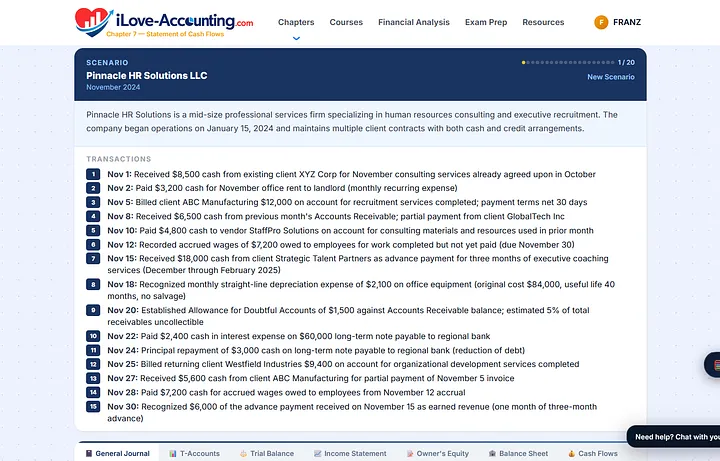
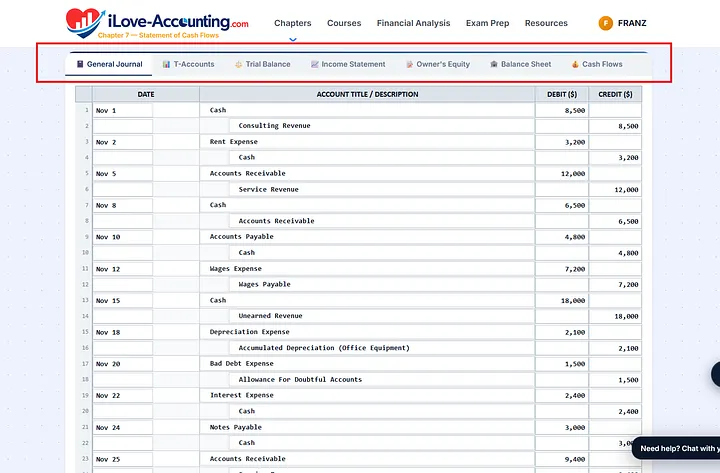
Practicing in a real spreadsheet means the skill transfers straight from studying to the exam, and from the exam to a job.
Why It Works: Repetition Plus Correction
Mastery comes from repetition, and this gives you unlimited reps — every scenario is freshly generated, so the problems never run out. Correction comes from instant, precise feedback on every single step. Put those together and the patterns stop being something you think about and become something you just know. The first time you record an owner’s investment, you pause. By the fiftieth, it is automatic. That is the moment the exam stops being scary.
The Bottom Line
I built this because I know exactly what it feels like to be one step behind in an accounting class — I was the oldest student in mine. Practice is free across the whole platform, no account needed to try Chapter 1. The full experience, all seven chapters, both modes, instant grading on everything, and the certificates, is $4 a month.
Judge it yourself: iLove-Accounting.com. And if something is wrong or confusing, tell me — the builder is reading.